Press Release · NASA
Scotland’s Flow Country
Distributed by Endless Tech · Originally issued via NASA

- Science
- Earth Observatory
- Scotland’s Flow Country
- Earth
- Earth Observatory
- Image of the Day
- EO Explorer
- Topics
- More Content
- About
- Search
Compared to ecosystems in many other parts of the world, the blanket bogs of the Flow Country in northern Scotland are unassuming—soggy, treeless landscapes dominated by hummocky mosses, grasses, and heathers. Yet, to ecologists, the seemingly desolate areas are nothing short of extraordinary.
The bogs store tremendous quantities of carbon. That’s because their soils are so waterlogged that microbes cannot fully break down dead plant material, a process that would otherwise release carbon dioxide. Instead, partially decayed plant matter accumulates into thick layers of spongy, crumbly, carbon-rich material called peat.
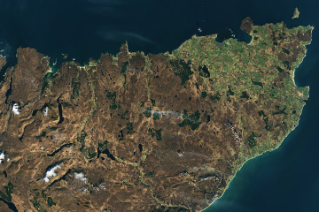
The unusual ecosystems, also called blanket mires and featherbed bogs, only occur in places with abundant rainfall, poor drainage, and low levels of evapotranspiration. These types of bogs cover just 120,000 square kilometers (46,000 square miles) globally, less than one-tenth of one percent of Earth’s land surface. The image above, captured by the OLI (Operational Land Imager) on Landsat 8, is centered on blanket bogs in the Scottish Highlands, home to the largest such ecosystem in Europe. This peatland is also the first of its type to be inscribed as a UNESCO World Heritage Site.
The peat bogs of northern Scotland, home to more than 30 species of sphagnum moss, are spread across some 1,900 square kilometers (730 square miles) of the country’s Highlands region. In this image, boggy areas appear dark brown and are sprinkled with lakes. The light green area on the right side around Thurso is farmland. The darker green geometric patterns in the center are conifer plantations. The image was captured in the spring, the part of the year when the land surface is most waterlogged and peat bogs begin to accumulate large amounts of new biomass.
While forests store most of their carbon in living trees—which eventually release it back into the atmosphere when they burn or die—peat bogs often store carbon for many thousands of years. Some parts of the Flow Country have been accumulating peat for more than 9,000 years, building deposits exceeding eight meters thick, according to UNESCO. Overall, scientists estimate that all of the world’s peatlands cover just 3 percent of Earth’s land surface but store more than 600 gigatons of carbon—about twice as much as all the world’s forests combined.
NASA Earth Observatory images by Michala Garrison, using Landsat data from the U.S. Geological Survey. Story by Adam Voiland.
Downloads
March 4, 2024
JPEG (7.52 MB)
References & Resources
- Aitkenhead, M.J. (2016) Mapping peat in Scotland with remote sensing and site characteristics. European Journal of Soil Science, 68(1), 28-38.
- BBC (2020, August 3) Scotland’s 10,000-year-old wild heartland. Accessed November 10, 2026.
- The Flow Country Partnership, The Flow Country. Accessed November 10, 2026.
- Lindsay, R. & Anderson, R. (2016) Blanket Mires of Caithness and Sutherland, Scotland’s Great Flow Country (UK). The Wetland Book. (Springer: Dordrecht).
- Michigan Tech (2019) Peatlands cover 3 percent of land and store 30 percent of soil carbon. Accessed November 10, 2026.
- NatureScot (2024, July 26) Scotland’s The Flow Country secures World Heritage Site status. Accessed November 10, 2026.
- NatureScot (2026, August 27) Blanket bog. Accessed November 10, 2026.
- Warren, C. (2008) Birds, bogs and forestry’ revisited: The significance of the flow country controversy. Scottish Geographical Journal, 116(4), 315-337.
You may also be interested in:
Stay up-to-date with the latest content from NASA as we explore the universe and discover more about our home planet.
Brown carbon, emitted by wildland fires and tracked over the span of a week in July 2026, worsened air quality…
Article
Fall color covers the forested slopes of Bieszczady National Park, while patches of polonina, a type of high-mountain meadow, have…
Article
Over the years, astronauts aboard the International Space Station have photographed several of the cities hosting the 2026 FIFA World…
Article1
2
3
4
Next
Keep Exploring
Discover More from NASA Earth Science
Subscribe to Earth Observatory Newsletters
Subscribe to the Earth Observatory and get the Earth in your inbox.

Earth Observatory Image of the Day
NASA’s Earth Observatory brings you the Earth, every day, with in-depth stories and stunning imagery.
Explore Earth Science

Earth Science Data
Open access to NASA’s archive of Earth science data